_AZ_Initial.png)
_AZ_Initial.png)
MEDICARE'S NEW GLP-1 BRIDGE PROGRAM
Michael T. Braden May 7, 2026 MEDICARE NEWS
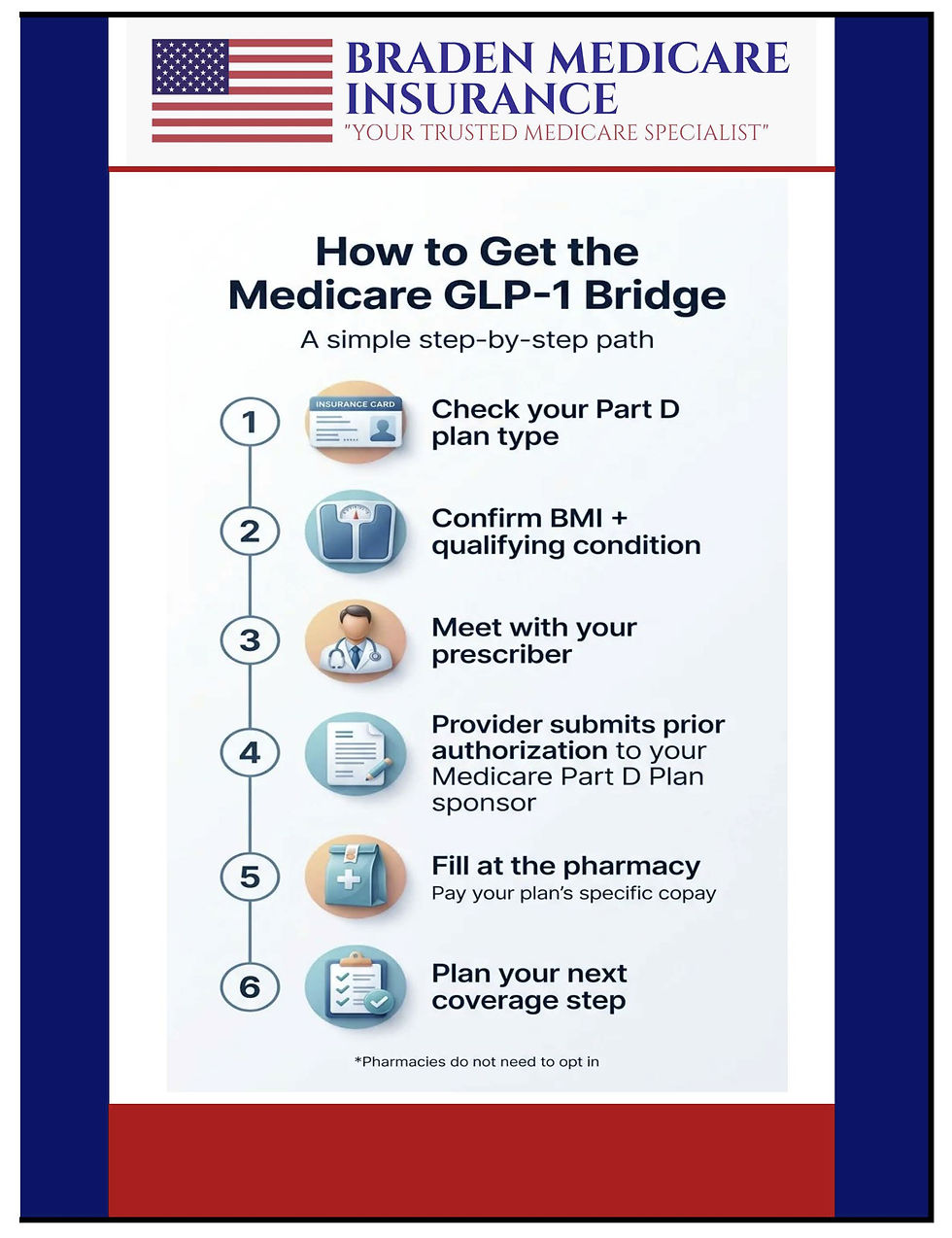
Medicare is launching a new short-term program called the GLP-1 Bridge, providing Part D enrollees access beginning July 1, 2026. This article explains who qualifies, what drugs are covered, and how to get started.
WHO IS ELIGIBLE FOR GLP-1 DRUGS UNDER MEDICARE’S NEW BRIDGE PROGRAM?
For years, people covered by Medicare had little to no access to prescription medications approved specifically for weight management. That changed May 6, 2026, in a major announcement sure to have dramatic implications for seniors & the pharmaceutical industry when the Centers for Medicare & Medicaid Services (CMS) announced the details of the Medicare GLP-1 Bridge — a short-term demonstration program designed to give eligible Medicare Part D enrollees access to certain GLP-1 weight-loss drugs beginning July 1, 2026.
WHAT IS THE MEDICARE GLP-1 BRIDGE PROGRAM?
The Medicare GLP-1 Bridge is a federal demonstration program administered by CMS. It will run from July 1, 2026, through December 31, 2027, and operates separately from the standard Medicare Part D drug benefit. As a result, the program has its own prior authorization process, claims system, and payment structure.
CMS is using Humana — which already administers the federal Limited Income Newly Eligible Transition (LI NET) program — as the central processor. Humana will handle prior authorizations, process pharmacy claims, and pay pharmacies directly for drugs dispensed under the Bridge.
Importantly, your Part D plan does not need to opt in to this program. If you meet the eligibility criteria, you can access the covered GLP-1 drugs through this program regardless of which Part D plan you are enrolled in.
The program is available in all 50 states and U.S. territories.
WHO CAN PARTICIPATE IN THE BRIDGE PROGRAM?
Eligibility for the GLP-1 Bridge comes down to two sets of requirements: your plan enrollment type and your clinical profile.
ENROLLMENT REQUIREMENTS FOR THE BRIDGE PROGRAM
To qualify, you must be enrolled in one of the following Medicare drug coverage plans:
· A standalone Medicare Part D Prescription Drug Plan (PDP)
· A Medicare Advantage plan with prescription drug coverage (MA-PD), including HMOs, HMO Point-of-Service plans, and Local or Regional PPO plans.
· People enrolled in Special Needs Plans (SNPs) and dually eligible individuals (those enrolled in both Medicare and Medicaid) who are in an eligible plan type are also able to participate.
However, not all plan types are included. According to CMS's official guidance on the Medicare GLP-1 Bridge, people enrolled in private fee-for-service plans, PACE organizations, section 1876 cost contract plans, section 1833 health care prepayment plans, fallback plans, religious fraternal benefit plans, and employer or union group waiver plans (EGWPs) are generally not eligible — unless they are also enrolled in a standalone PDP.
ELIGIBILITY CRITERIA
Beyond plan enrollment, you must also meet specific medical criteria that your provider will attest to when submitting a prior authorization request on your behalf. The drug must be prescribed to reduce excess body weight and maintain weight reduction, in combination with lifestyle modification — including structured nutrition and physical activity — consistent with the applicable FDA-approved label.
THERE ARE THREE OPTIONS/PATHWAYS FOR THE MEDICARE GLP-1 BRIDGE PROGRAM
Option/Pathway 1 — BMI of 35 or higher: You are at least 18 years old and have a BMI of 35 or above when you began GLP-1 therapy. No additional diagnosis is required.
Option/Pathway 2 — BMI of 30 or higher, with a qualifying condition: You are at least 18 years old, have a BMI of 30 or above when you began therapy, and have been diagnosed with one of the following:
· Heart failure with preserved ejection fraction
· Uncontrolled hypertension (systolic blood pressure above 140 mm Hg or diastolic above 90 mm Hg, despite taking two antihypertensive medications)
· Chronic kidney disease, stage 3 or higher
Option/Pathway 3 — BMI of 27 or higher, with a qualifying condition: You are at least 18 years old, have a BMI of 27 or above when you began therapy, and have been diagnosed with one of the following
· Pre-diabetes (as defined by American Diabetes Association guidelines)
· A previous heart attack (myocardial infarction)
· A previous stroke
· Symptomatic peripheral artery disease
One important note: the clinical criteria are assessed at the time you first started GLP-1 therapy — not necessarily at the time the prior authorization request is submitted. This matters for people who began a GLP-1 medication before enrolling in Medicare or before the Bridge program launched. For example, if someone started therapy in 2024 with a BMI of 37 but has since lost weight and now has a BMI of 34, their provider can still attest that they met the BMI ≥35 criterion at the time therapy was initiated.
WHICH MEDICATIONS ARE AVAILABLE FOR THE MEDICARE GLP-1 BRIDGE PROGRAM?
As of the program's April 2026 update, three medications are covered under the Medicare GLP-1 Bridge for weight management:
Foundayo (all formulations)
Wegovy (injection and tablet formulations)
Zepbound (Kwik Pen formulation only — the single-dose vial and single-dose pen are not included)
These drugs are covered specifically for weight reduction and maintenance. If a GLP-1 medication is prescribed for a different use — such as Zepbound for obstructive sleep apnea, or Wegovy to reduce the risk of major cardiovascular events — that prescription would be handled through the standard Part D benefit, not the Bridge program.
The list of covered drugs and their specific National Drug Codes (NDCs) may be updated over the course of the program. CMS has stated it will notify providers and pharmacies of any changes.
HOW MUCH DOES THIS GLP-1 BRIDGE PLAN COST?
The out-of-pocket cost for beneficiaries participating in the Medicare GLP-1 Bridge is a flat $50 copay per monthly supply, regardless of which phase of the Part D benefit you are in. This is a key distinction from standard Part D drug coverage, where your cost-sharing can change depending on whether you are in the deductible, initial coverage, or catastrophic phase.
It is also worth knowing that the $50 copay and the cost of the drug itself do not count toward your Part D plan's true out-of-pocket (TrOOP) calculation. Similarly, low-income cost-sharing subsidies (also called Extra Help) do not apply to the Bridge program copay.
Participating drug manufacturers have agreed to supply eligible GLP-1 drugs at a net price of $245 per monthly supply. Pharmacies are reimbursed at the wholesale acquisition cost, minus the copay, plus a dispensing fee.
Coupons and discount programs cannot be applied to Medicare GLP-1 Bridge claims.
HOW CAN YOU ACCESS THIS BRIDGE PROGRAM?
The process begins with your medical provider/doctor. To get coverage through the Medicare GLP-1 Bridge, your provider must:
Submit a prior authorization request to the central processor (Humana, acting on behalf of CMS), attesting that you meet the clinical criteria described above.
Prescribe one of the covered GLP-1 drugs.
Providers do not need to be enrolled in Medicare to write the prescription or submit the prior authorization. Still, they must not appear on Medicare's Preclusion List — a list of providers who are barred from participating in Medicare programs.
Once the prior authorization is approved, you can fill your prescription at a participating pharmacy. Pharmacies do not need to opt in to the program; they automatically participate. Claims are submitted electronically through a specific Bank Identification Number (BIN) and Processor Control Number (PCN) established by CMS for the Bridge program.
CMS has indicated it will release detailed guidance on prior authorization processes and pharmacy claims procedures ahead of the July 1, 2026, launch.
MISCONCEPTIONS AND MYTHS REGARDING THIS NEW GLP-1 BRIDGE PROGRAM
Understanding any new government program isn't always as well-defined and straightforward as we would like. Here are some of the most common misunderstandings about the Medicare GLP-1 Bridge — and the facts that clear them up.
Myth 1
Any Medicare beneficiary can get GLP-1 drugs through this program. Not quite. You must be enrolled in an eligible type of Part D plan and meet specific clinical criteria related to your BMI and health history. People in certain plan types — like PACE organizations, private fee-for-service plans, or employer group waiver plans — generally do not qualify.
Myth 2
If your BMI is lower than it was when you started treatment, you no longer qualify. This is not correct. Eligibility is based on your BMI and health status at the time you first began GLP-1 therapy, not your BMI today. Someone who has lost weight since starting treatment may still qualify if they met the criteria at the time therapy was initiated.
Myth 3
Your Part D plan needs to approve or cover the drug under the Bridge program. Your Part D plan does not need to take any special action for you to access the Bridge. The program operates separately from standard Part D coverage. If your plan receives a prior authorization request for a GLP-1 drug for weight management, CMS strongly encourages the plan to redirect the provider to the central processor — but the Bridge program functions independently.
Myth 4
Your GLP-1 drug costs under the Bridge program count toward your Part D out-of-pocket maximum. They do not. Spending through the Bridge program is not counted toward your TrOOP total under your Part D plan. This also means that Extra Help (low-income subsidy) benefits do not reduce your Bridge copay.
Myth 5
Only people who start GLP-1 therapy after July 1, 2026, can participate. People who were already taking a covered GLP-1 drug before the program launched — including those who began treatment before enrolling in Medicare — may still be eligible, as long as they met the clinical criteria when they first started therapy.
WHAT TO DO NEXT
If you think you or a family member might qualify for coverage through the Medicare GLP-1 Bridge, here are practical steps to take:
Confirm your plan type. Check whether you are enrolled in a standalone PDP, an MA-PD plan (HMO or PPO), or a Special Needs Plan. If you are unsure, call the number on the back of your Medicare ID card or log in to Medicare.gov.
1. Talk with your doctor or prescriber. Ask whether a covered GLP-1 medication is appropriate for you and whether you meet the clinical criteria — particularly in terms of BMI at the time you first began (or would begin) therapy, and any qualifying diagnoses.
2. Ask your provider to submit a prior authorization. The prior authorization must go through the Bridge program's central processor, not your Part D plan. Your provider will need to attest that you meet the clinical criteria.
3. Clarify your BMI history. If you have already been taking a GLP-1 drug, make sure your provider has access to your medical records from when therapy was first initiated, since eligibility is based on that point in time.
4. Understand the cost structure. Plan for a $50 copay per monthly fill. Know that this expense does not count toward your Part D deductible, coverage gap, or true out- of-pocket total.
5. Check for program updates. CMS has indicated it will release additional guidance in Spring 2026. Keep an eye on CMS's dedicated GLP-1 Bridge page for the latest information on prior authorization processes and participating drugs.
6. Seek independent Medicare counseling if needed. Your State Health Insurance Assistance Program (SHIP) offers free, unbiased Medicare counseling. Find your local SHIP at shiphelp.org.
FAQ’S ABOUT THE MEDICARE GLP-1 BRIDGE PROGRAM
WILL THE MEDICATIONS BE AVAILABLE NATIONWIDE?
Yes. The program is available in all 50 states and U.S. territories, and it is open to eligible beneficiaries regardless of which state they live in.
CAN I ACCESS THIS PROGRAM IF I HAVE MEDICARE PART C?
Yes, if you are enrolled in an MA-PD plan — which is a Medicare Advantage plan that includes prescription drug coverage through an HMO, HMO Point-of-Service, or PPO arrangement — you may be eligible. However, if your Medicare Advantage plan does not include drug coverage, or if you are enrolled in a private fee-for-service plan, you would not qualify unless you also have a standalone PDP.
IS IT OKAY IF I HAVE NEVER USED PRESCRIPTION MEDICATION FOR WEIGHT LOSS IN THE PAST?
The CMS clinical criteria published for the Medicare GLP-1 Bridge do not require that you have tried and failed other weight-loss treatments before becoming eligible. The criteria focus on your BMI at the time of GLP-1 therapy initiation and whether you have any of the listed qualifying health conditions.
WHAT HAPPENS IF THESE MEDICATIONS ARE NOT IN MY DRUG PLAN’S FORMULARY?
The Bridge program operates independently of your Part D plan's formulary. Even if a covered GLP-1 drug is not on your plan's formulary, you can still access it through the Bridge if you meet the eligibility criteria.
WHAT IF MEDICARE SETS A NEW PRICE FOR ANY OF THESE THREE MEDICATIONS?
CMS has confirmed that the negotiated Maximum Fair Price (MFP) for Wegovy — which is part of the Medicare Drug Price Negotiation Program — does not take effect until January 1, 2027. For the 2026 portion of the Bridge program, the negotiated price and the Bridge program operate independently. CMS has stated that more information about how these two programs will interact in 2027 is forthcoming, per the Medicare GLP-1 Bridge FAQ.
IS IT OKAY TO USE MANUFACTURERS COUPONS OR A DISCOUNT CARD TO REDUCE THE $50 COPAY?
No. Coupons, manufacturer discount programs, and similar tools cannot be applied to claims submitted through the Medicare GLP-1 Bridge.
DOES MY DOCTOR HAVE TO ACCEPT MEDICARE TO PRESCRIBE MY MEDICATIONS THROUGH THE BRIDGE?
Yes. Consistent with how Medicare Part D generally works, a provider does not need to be enrolled in Medicare to write a prescription or submit a prior authorization request under the Bridge program. The only restriction is that the provider must not appear on Medicare's Preclusion List, which bars certain providers from participating in Medicare programs.
WRAPPING THINGS UP
We all hope you found this article about the new Medicare GLP-1 Bridge Program as informative and exciting as we did. There are currently no other updates at the time of this article's publication. But please stay tuned, and we will be sure to add any further updates as they become available.


